Your Cart (0)


Celtic Wedding Bands
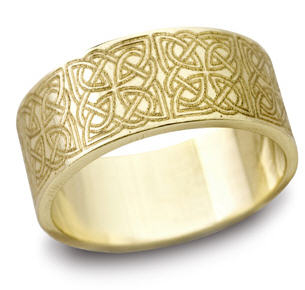 Many couples are drawn to Celtic wedding bands for their beautiful designs and symbols engraved into the ring. However, few people actually know the meaning behind the handsome swirls, folds and spirals. If you love the look of Celtic wedding bands but have no clue what the symbols mean, you’ve come to the right place. Read on for our little tutorial on the meanings behind Celtic symbols, and choose your wedding band with knowledge and confidence.
Shield Knots
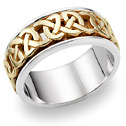 Shield knots can either be square or a circle with the knot inside, and represent a protective force to ward off evil and bad spirits. They are some of the most common symbols found on Celtic wedding bands, and for good reason. With the knots, there is no beginning and no end. Many couples feel that this represents the unbroken vow of marriage that should last for eternity.
If you like shield knot Celtic wedding rings, consider our 14K yellow gold wide celtic filigree band. Look closely at the intricately woven design and you’ll see a hidden cross in the center of the knot-work. Also available as a white gold celtic filigree band and rose gold celtic filigree band.
Spirals – Double Spiral or Single Spiral
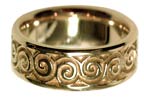 A single Celtic spiral represents energy and consciousness while the double spiral is a sign of balance and equality. For couples who love the Celtic spirals, a 14K gold celtic spiral design ring is the perfect choice.
Five-Fold
The fivefold Celtic symbol is made up of five interlocking circles. The four outer circles represent the four elements, and the innermost circle represents achieving harmonious balance.
Triquetra
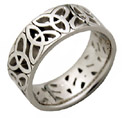 The triquetra looks like three pointed knots in the shape of a triangle. Triquetras are a holy symbol that represents either the Father, the Son and the Holy Ghost, or the Spirit, Mind and Body. Throughout Celtic history the symbols came to represent a host of different things, which is why the triquetra has two alternate meanings. If you like the triquetra symbol, take a look at our 14K White Gold Celtic Triquetra Wedding Band.
Combination Celtic Symbols
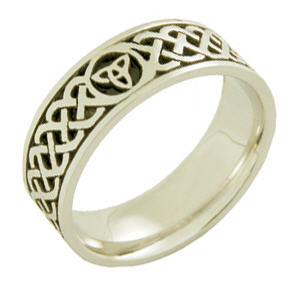 Many Celtic wedding bands are actually a combination of two or more different symbols. The combined designs work together to give the band a richer symbolic meaning. Take, for instance, our 14K White Gold Celtic Trinity Knot Wedding Band. The intricate design is actually a mixture of the triquetra and the spiral. Together, the two symbols can represent living your faith energetically and with enthusiasm.
Related Posts

Recent Posts
7 Ways To Stay Spiritually Connected As A Busy Parent
5 Ways To Help Single Christian Moms Who Feel Overwhelmed
Learn How To Raise Godly Children In The Home
10 Positive Affirmations For Christians
5 Important Priorities As Christians
Seasons Change But The Word Of God Stays The Same
3 Reasons Why We Should Pray Over Our Household
What It Truly Means To Be Born Again